

What Is Orthodontic Treatment?
Orthodontic treatment focuses on correcting misaligned teeth and jaws. It helps improve both function and appearance. Properly aligned teeth are easier to clean, less prone to decay, and reduce the risk of gum disease.
Orthodontic care is suitable for children, teenagers, and adults, depending on the case.

Understanding Dental Braces
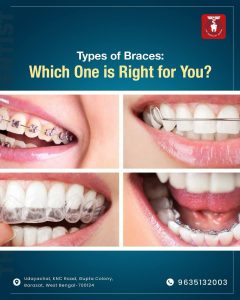
Dental braces are a traditional and widely used orthodontic treatment. They consist of brackets attached to the teeth and connected by wires. Over time, gentle pressure moves the teeth into the correct position.
Types of Dental Braces
-
Metal braces
-
Ceramic braces
-
Lingual braces (placed behind the teeth)
Although braces have evolved over the years, they remain a reliable solution for complex orthodontic cases.
Understanding Clear Aligners
Clear aligners are a modern alternative to braces. They are custom-made, transparent trays that fit snugly over the teeth. These trays are changed periodically to gradually move the teeth.
Because they are nearly invisible, aligners are especially popular among adults and working professionals.

Braces vs Aligners: Key Differences
Although both treatments aim for the same result, there are important differences between them.
Appearance
-
Braces: Visible on teeth
-
Aligners: Almost invisible
Removability
-
Braces: Fixed and cannot be removed
-
Aligners: Removable during eating and cleaning
Comfort
-
Braces: May cause irritation initially
-
Aligners: Generally more comfortable
Maintenance
-
Braces: Require careful cleaning
-
Aligners: Easier to maintain oral hygiene
Treatment Complexity
-
Braces: Suitable for all types of cases
-
Aligners: Best for mild to moderate cases
Who Needs Dental Braces?
Braces are often recommended for patients with moderate to severe orthodontic problems.
You may need braces if you have:
-
Severe crowding
-
Complex bite issues (overbite, underbite, crossbite)
-
Rotated or tilted teeth
-
Jaw alignment problems
Braces provide precise control over tooth movement, making them ideal for challenging cases.
Who Needs Clear Aligners?
Clear aligners are suitable for patients seeking a discreet orthodontic solution.
You may be a good candidate for aligners if you have:
-
Mild to moderate crowding
-
Spacing between teeth
-
Minor bite issues
-
A preference for removable appliances
Patient compliance is very important with aligners. Wearing them for the recommended hours daily is essential for success.
Success Rate of Braces and Aligners
Both braces and aligners have high success rates when used correctly and under professional supervision.
Braces Success Rate
-
Success rate: 95–98%
-
Effective for all age groups
-
Predictable results in complex cases
Aligners Success Rate
-
Success rate: 90–95%
-
Highly effective for suitable cases
-
Depends heavily on patient compliance
Regular follow-ups and good oral hygiene play a crucial role in treatment success for both options.

Duration of Treatment
Treatment duration varies depending on the complexity of the case.
-
Braces: Usually 12–24 months
-
Aligners: Usually 6–18 months
Your orthodontist will provide a personalized timeline after evaluation.
Cost Consideration
The cost of orthodontic treatment depends on several factors such as case severity, treatment duration, and type of appliance.
While aligners may seem costlier initially, the overall value depends on comfort, convenience, and lifestyle preferences.
Choosing the Right Option for You
There is no one-size-fits-all solution. The right orthodontic treatment depends on:
-
Dental condition
-
Age
-
Lifestyle
-
Aesthetic expectations
-
Budget
A professional orthodontic consultation is essential to choose the most suitable option.
Why Choose The Specialist Dentist?
At The Specialist Dentist, we provide personalized orthodontic solutions using advanced diagnostic tools and patient-centric care. Our goal is to deliver healthy, confident smiles with comfort and precision.
📍 Location: Udayachal, KNC Road, Gupta Colony, Barasat – 700124
📞 Call: 9635132003
🌐 Website: www.thespecialistdentist.in
